The Original Settlers in Puerto Rico
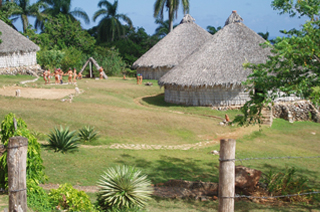
Reconstruction of a Taino village in Chorro de Maíta, Cuba. "Reconstruction of Taino village" by Michal Zalewski is licensed under CC BY SA-3.0.
To understand the historical qualities of Puerto Rico, we must understand the earliest tribes to settle on the island. Contrary to some beliefs, the earlist inhabitants on what would become the Puerto Rican Islands were hunter-gatherers. It is believed that the Arwak Indians were among the first settlers around 1000 CE [1]. The Taíno were amongst the more popular settlers on the island coming from large groups. As a whole, the Taíno migrated from South America and were divided into three groups. These three groups were the western Taíno (Jamaica, Cuba, and the Bahamas), the Classic Taíno (Hispaniola and Puerto Rico), and the Eastern Taíno (northern lesser Antilles).[2] The Eastern Taíno villagers migrated to the islands that would eventually become Puerto Rico. Prior to the naming of Puerto Rico, the islands were named "Borikén" (meaning, "the land of the brave lord") by the Taíno. While their knowledge of agrigulture wasn't strong, they grew simple crops like pineapples, sweet potatoes, and based their diet around seafood. This is one of the reasons why modern Puerto Rican citizens become fishermen; the large bodies of water enable access to many fish across the islands. As a practice of religion, the Taíno believed in their supreme god, Zemi. Zemis would offer spiritual advice and the practice of sniffing chohoba for cleansing and healing. It was estimated that somewhere between 20,000 to 50,000 Taíno settlers lived on Borikén [2].
Spain Colonizes the Island
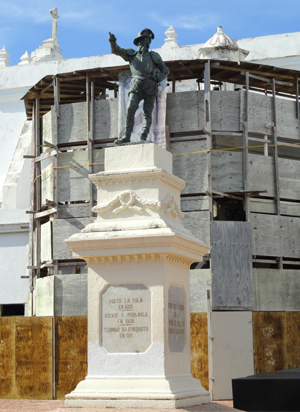
Bronze statue of Spanish explorer Juan Ponce de León in Plaza de San José, San Juan.
In 1493, Christopher Columbus sailed from Spain to expand Spanish control of various territories. It was speculated that Borikén contained vast gold and wealth; perfect qualities for an explorer's interest. When the island was claimed for Spain, it was renamed "San Juan Bautista" to honor Saint John the Baptist. Even though the island was under Spanish control, it has been said that the island was largly neglected unless it was for supply purposes. Juan Ponce de León, one of Columbus' former lieutenants noticed Taíno prisoners held captive by the Carib tribe. They were freed from the Spaniards on the condition of working for them. The then-current chief of Borikén, Agüeybaná practiced a ritual where he would exchange names with Ponce de León and act peacefully. His mother warned him about making enemies of the Spaniards and urged Agüeybaná to establish peace or the tribe will be slaughtered [3]. Relationships between the Taíno settlers and Spanish explorers quickly turned sour once Ponce de León subjected the tribes as slaves and governed the islands by 1509 [4]. The Taino tribes were reduced to working-class peasants due to the enforced encomienda system by the Spaniards.
Spanish-Taíno War
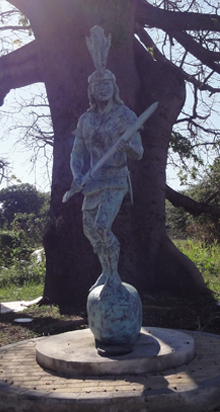
Statue of Agüeybaná II in Ponce, Puerto Rico.
Following the events of Spanish colonization and the enslavement of the Taíno, the tribes attempted to retaliate by declaring war in 1511. It is believed that the Spanish had several hundreds of men while the Taíno tribe had thousands. While outnumbered, the tribe was determined to fight for their honor and freedom. Following the death of senior chief Agüeybaná in 1510, Agüeybaná II would succeed as the most powerful chief on the entire island. Agüeybaná II grew suspicious of the supposed godly nature of the Spaniards, so he developed a plan to disprove this. He would lure Diego Salcedo out to a river and drown him. Designated Taíno tribes would watch over him to convince the Taíno that the Spaniards were not gods [5]. The legacy of Agüeybaná II is still honored to this day in Puerto Rico, as a school, a street, and several events were named after him. In the center of Ponce, Puerto Rico, a statue commemorating Agüeybaná II's efforts in battle can be seen. The statue is a depiction of him proudly leading the Taino tribe into battle, standing tall against any adversary.
Remembering and Honoring a Lost Tribe
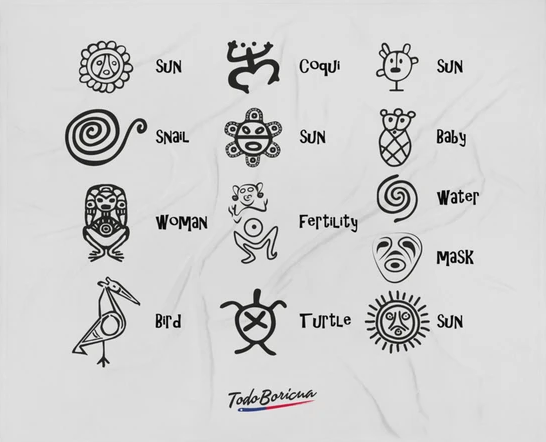
Various Taíno symbols surviving in modern Puerto Rican Culture. The coqui and sun are commonly seen on tattoos.
Unfortunately, many aspects of Taíno history were lost or destroyed over the course of time. Numerous invasions and attacks on the island destroyed many early settling sites. There's only so much information currently known about their backgrounds. By 1565, it was declared the Tainos were extinct, but studies suggest that over 60% of Puerto Ricans have ancestrial DNA from these tribes [6]. As such, modern Puerto Ricans respect the original Taíno cultural qualities, and have adopted them into their lives. One such example is the integration of Taíno symbols into artwork, tattoos, and visual communication. The origins of these symbols comes from carvings on petroglyphs. Many of these symbols have been compared to similar languages and styles like hyroglifics. In the current Puerto Rican language, some of the most popular forms of Taíno synbols include trees (ceiba, tabonuco, and cupey), an iguana, coqui (named after a frog that makes a similar noise to the word "coqui"), and guabina. In particular, the coqui is commonly seen as a tattoo on Puerto Ricans. This is because certain symbols also refer to the characteristics of an individual. For instance, symbols such as lizards, snakes, and turtles translate to survival and strength.[6] Today, Puerto Ricans have these tattoos to show pride in their Native American heritage.
References
1. Mathews, Thomas G.; Wagenheim Kal; Wagenheim, Olga J.; The Editors of Encyclopaedia Britannica. "History of Puerto Rico". Encyclopædia Britannica. Retrieved February 18, 2022.
2. "Taíno: Indigenous Caribbeans". www.blackhistorymonth.org.uk. 2 December 2021. Retrieved February 18, 2022.
3. Historia general y natural de las Indias, islas y tierra-firme del mar oceano (in Spanish). 23 October 1851. p. 467. Retrieved 6 November 2019 – via Internet Archive. Retrieved February 18, 2022.
4. "Puerto Rico". Genocide Studies Program, Yale. Retrieved February 18, 2022.
5. Bryan, Cathy. Land Tenure Development in Puerto Rico. Archived 2006-09-13 at the Wayback Machine. Department of Spatial Information Science and Engineering. University of Maine. Orono, Maine. ca. 2000. Old Town, Maine: James W. Sewall Company. Page 5. Retrieved February 19, 2022.
6. "Taino Symbols and Meanings". Puerto Rico Travel Guide. Retrieved February 20, 2022.