Puerto Rican History
Early Developmental Age
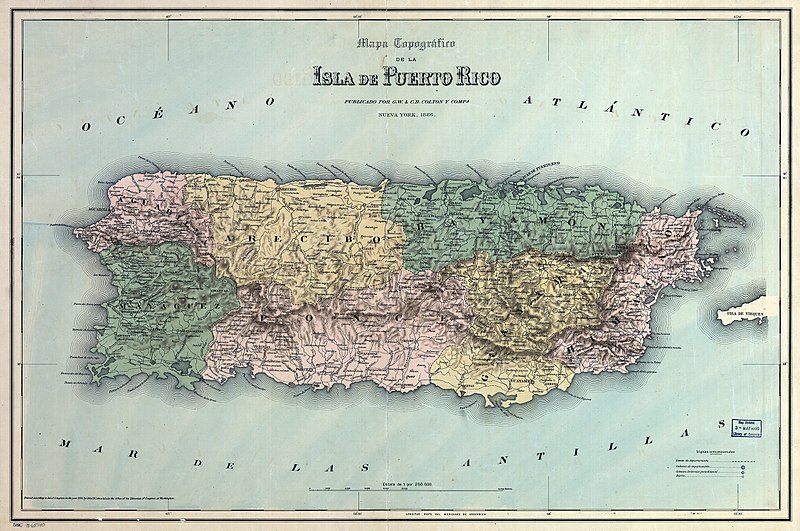
Puerto Rico during Spanish provincial times (est. 1896)
Puerto Rico is one of the most interesting countries with an extensive historical background. While many of the original traces have mostly survived due to recorded accounts, one important thing remains: it was the influence of Taíno culture that shaped Puerto Rico today. When they lived on the island, it was known as Borikén. After the Spaniards settled and took control of the land, it was renamed Puerto Rico in 1521 [1]. It was a simple land that produced cattle, sugar canes, coffee, and tobacco. Puerto Rico was one of the many lands involved in the Atlantic Slave Trade, which resulted in the importation of Slaves from African lands [2]. Following the aftermath of the slave trade, many citizens of modern Puerto Rican citizens are descendants of Spanish, African, or Taíno ancestors.
European Powers Attempt to Control Puerto Rico
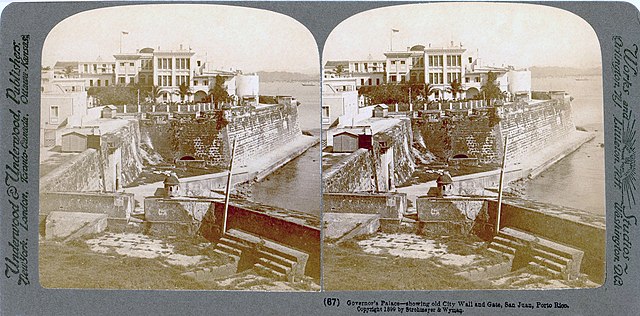
La Fortaleza in 1899
Once Puerto Rico was controlled by the Spanish explorers of the 15th century, many other countries began to find an interest in possible wealth. Often times, this was meant with hostility and attempted destruction of prominent areas within the island. The French burned most of San Germán in 1528. Many original settlements including Guánica, Sotomayor, Daguao and Loíza were sabatoged in the attack, forcing an eventual rebuilding of each location. In a desparate attempt to retain control of Puerto Rico, Spain would increase fortifications to prevent invasions within the islands. La Fortaleza was the first fort to be constructed in 1532 to defend San Juan Bay [3]. While the fortifications protected Puerto Rico in the 16th century, the 17th and 18th centuries saw more attacks than ever. Following an attempted sack by the Dutch in 1625, further fortifications in San Juan continued. In 1702, the Kingdom of England attempted to capture Arecibo with no success. This would eventually lead to Spain declaring war with Great Britain in 1797, where Great Britain sought to invade San Juan [4].
19th Century History
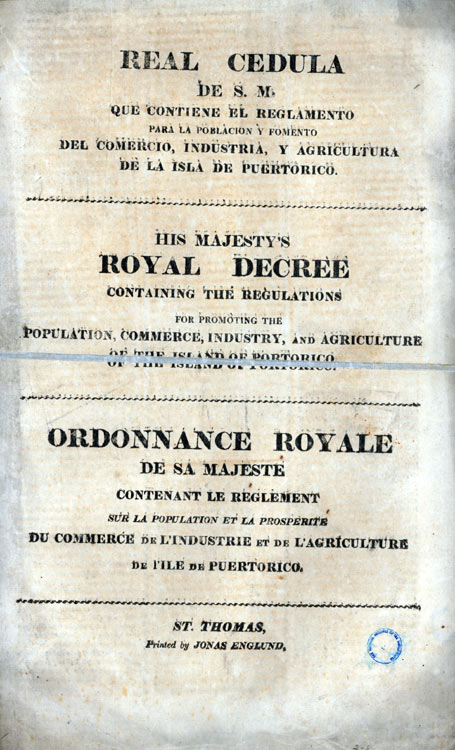
Royal Decree of Graces of 1815: this would allow foreigners to enter Puerto Rico.
In the early 19th century, Puerto Rico would undergo many changes in its social and political structure. The Supreme Central Junta (alternative administrations to the French invadors in the Napoleonic era) invited voting representatives. As a result, the Ley Power ("The Power Act") gave five spots for commerce: Fajardo, Cabo Rojo, Aguadilla, Mayagüez, and Ponce [5].The Political Constitution of the Spanish Monarchy (also known as the Cádiz Constitution) was enacted in 1812, which divided Spain and its territories into provinces, thus granting Puerto Rican citizens citizenship. Three years later in 1815, the Royal Decree of Graces was issued. This allowed foreigners to enter Puerto Rico, and opened trade ports with countries other than Spain [6]. Anybody who swore loyalty to the Spanish crown and the Roman Catholic Church was permitted free land. Once the Royal Decree of Grace was enacted, development of Puerto Rico quickly rose with the influence of cultural diffusion. Queen María Cristina abolished the slave trade to Spanish colonies on June 25, 1835.
United States Invasion and Annexation of Puerto Rico
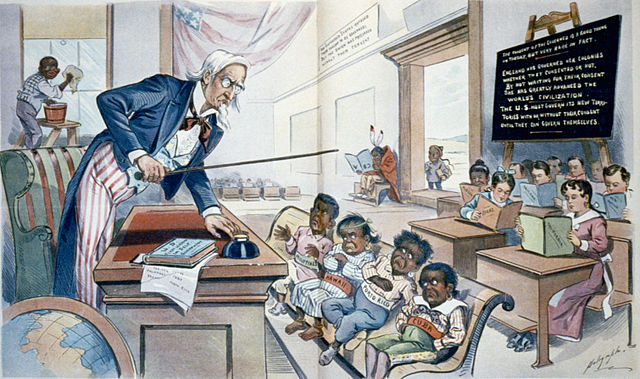
Caricature by Louis Dalrymple. Uncle Sam is strictly lecturing four black children labled "Phillipines", "Hawaii", "Porto Rico", and "Cuba". Puerto Rico is spelt "Porto Rico" due to United States control.
Interests of Puerto Rico extended past the possibility of wealth and trade. The United States wanted to expand its military operations and head to war against Spain. In late April 1898, the United States officially declared war against Spain following the sinking of the Battleship Maine in Havana harbor (sunk in February 1898), leading into the Spanish-American War [6]. The idea of the United States was to seize control of Cuba, Puerto Rico, the Philippines, and Hawaii. By the end of August, most of the island was under American control. To prevent further casualties and damage to the islands, peace protocols were discussed to widthdrawl Spanish troops and hand over the islands to the United States. On December 10, 1898, The Treaty of Paris was signed. The Treaty of Paris relenquished all claims of Spanish sovereignty over Cuba, and ceded Puerto Rico, the Philippines, and Guam [7]. Under the military control of the United States, Puerto Rico once again underwent signifigant changes. The island's name was changed to Porto Rico (reverted back to Puerto Rico in 1932), and the currency of the Puerto Rican peso was changed to the United States dollar [8]. The Puerto Rican flag was banned from 1895 to 1952, and the island used the United States' flag instead. Cockfighting was a prominent activity in Puerto Rico, but was illegal once the United States took control (legalized again in 1933). In 1950, it was reported that Puerto Rico had a record sugar crop growth following the influence of United States support [9]. On July 3, 1950, Harry S. Truman signed the Puerto Rico Federal Relations Act of 1950. This act permitted Puerto Rico to establish its own internal government and draft a constitution (while under the Gag Law). By 1952, the first constitution drafted in Puerto Rico was approved, which was also the same year the ban of Puerto Rican flag was lifted.
Puerto Rico in the Present
Royal Decree of Graces of 1815: this would allow foreigners to enter Puerto Rico.
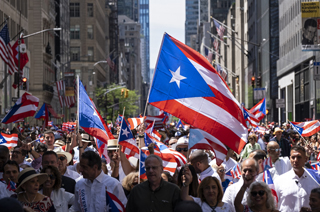
Today, Puerto Ricans celebrate their vast history involving different countries. Many of the festivities and cultural imagery come from other cultures. One of the most popular events celebrated in Puerto Rico is the Ponce Carnival. Paying homage to medival Spain, Puerto Ricans create vejigante masks and carry samples of cow bladder to "cleanse" the people. Puerto Rico is also known for preserving Taíno history, as their symbols and cultural qualities have been integrated into modern Puerto Rican culture. Today, the Taíno Cerimonial Ball Court is one of the biggest attractions in Puerto Rico. When taking a historical tour, the ball court is one of the first locations you will be taken to. Even if the modern Puerto Ricans never personally experienced the historical aspects about the island, they honor history by making it part of their lives.
References
1. Mathews, Thomas G.; Wagenheim Kal; Wagenheim, Olga J.; The Editors of Encyclopaedia Britannica. "History of Puerto Rico". Encyclopædia Britannica. Retrieved February 20, 2022.
2. "Implications of the slave trade for African societies". www.bbc.co.uk
3. "La Fortaleza/San Juan National Historic Site, Puerto Rico". National Park Service. Archived from the original on February 8, 2006. Retrieved February 20, 2022.
4. Alonso, María M. "Chapter XIV – Abercromby's Siege" (PDF). The Eighteenth Century Caribbean & The British Attack on Puerto Rico in 1797. Archived from the original on July 3, 2007. Retrieved February 20, 2022.
5. "Aspectos políticos en Puerto Rico: 1765–1837" (in Spanish). Retrieved February 20, 2022.
6. "¡Viva la Pepa! 1812, las Cortes de Cádiz y la primera Constitución Española" (in Spanish). National Geographic España. Retrieved February 21, 2022.
7. "The World of 1898: The Spanish–American War". Hispanic Division, Library of Congress. Retrieved February 21, 2022.
8. Puerto Rico is spelled as "Porto Rico" in the treaty. "Treaty of Peace Between the United States and Spain; December 10, 1898". Yale. 2009. Retrieved February 21, 2022.
9. "Military Government in Puerto Rico". Hispanic Division, Library of Congress. Retrieved February 21, 2022.
10. "Record crop in Puerto Rico". Daily Mercury (Mackay, Qld. : 1906 - 1954). 9 November 1950. Retrieved February 21, 2022.